

News

March 2019
Connect | Share | Learn | http://sdnetworkwi.org/

2019 Self-Determination Conference
Save the date! The 2019 Self-Determination Conference will be October 14th-16th at the Kalahari Resort and Conference Center in Wisconsin Dells. Are you interested in presenting? Presentation proposals (to present on the 15th and 16th) are now being accepted and are due by noon on April 2nd. Submit your proposal today!
State Budget Training
Late last month, Governor Evers unveiled his proposed budget. It addresses many issues facing the disability community such as transportation, caregiving, the Children's Long Term Care program, and special education funding. Want to learn about what’s in the Wisconsin State Budget? Concerned about whether supports people with disabilities need will continue to be funded? Attend a State Budget Training in your area.
The Wisconsin Board for People with Developmental Disabilities, The Arc Wisconsin and Disability Rights Wisconsin are partnering to bring budget trainings to as many communities as possible during the months of March and April. Find out where and when these trainings are!

The Self-Determination Network includes some very talented members and we want to help you to get to know each other a little better. Member Spotlight is a great way for us to get to know each other better.
For March, we shine the spotlight on Ginger. When this self-advocate isn't busy attending meetings for People First where she fiercely advocates for people with disabilities, she loves watching Wisconsin sports. Stop by this month's Member Spotlight to get to know Ginger.

"Have you ever been somewhere when you suddenly pause for a moment and think to yourself, “How did I get here?” Many times, those moments can feel like an epiphany to people."

Take five minutes to check out what's happening on the Self-Determination Network:
-
Circles of Life Conference: Circles of Life is Wisconsin’s annual conference for families who have children with disabilities. Register by March 29th to get a discounted rate!
- Grant Opportunities: The National Institute on Disability, Independent Living, and Rehabilitation Research announced six new funding opportunities. Applications due April 15th and 16th. Find out about these great opportunities.
- Dip in Disability Employment: Recent statistics show a slowdown in disability employment compared to the previous year. Learn where Wisconsin ranks in employment for people with disabilities compared to other states.
- Task Force on Caregiving: It's well-known caregiving continues to be a critical issue in Wisconsin. Recently, Governor Evers announced his plans to establish a statewide Task Force on Caregiving. Read about what the task force will be doing to address the issue.
- Emergency Toolkit: A new toolkit is available to help programs that support older adults and people with disabilities, through the emergency planning process of preparedness, response, recovery, and mitigation activities. Read about what this toolkit includes.
- New Rules for Dentists: For people with disabilities, finding dental care is often a struggle. Learn how the American Dental Association recently revised its code of conduct to try to address the problem.
- Call for Nominations: The Centers for Medicare and Medicaid Services is working with the Administration for Community Living through the National Quality Forum to address quality measurement in person-centered planning. They're seeking individuals with experience in person-centered care to serve on a multi-stakeholder panel. Nominations are due March 29th.
- New Emojis: Apple recently announced that later this year 59 new emojis that represent people with disabilities will be released. Find out what kind of things will be included.
- ABLE Program Hopes to Expand: New legislation, known as the ABLE Adjustment Act, would make ABLE accounts accessible to thousands of more people. Read about how this would make it possible for thousands of more people to be able to save money without risking losing eligibility for crucial benefits.
- Renewed Push to Help People Leave Institutions: Lawmakers are making efforts to renew a federal program that helps people with disabilities move from institutions to community-based settings. Learn about how new legislation would help with this.

Here's a sample of upcoming events listed on the Self-Determination Network:
- Disability Advocacy Day: March 20th, 9:30a.m. to 3:30p.m., Monona Terrence, Madison WI
- Transportation Consumer Advocacy Team (TCAT): March 26th, 1p.m. to 3p.m., IndependenceFirst, Milwaukee WI
- Webinar: Differences Between The ADA And ABA Accessibility Standards: April 4th, 1:30p.m. to 3p.m., Online
- Long Term Care Advocacy Team: April 9th, 2:30p.m. to 3:30p.m., IndependenceFirst, Milwaukee WI
- 2019 Circles Of Life Conference: May 2nd & 3rd, Holiday Inn Convention Center, Stevens Point WI
- Dance Card: May 3rd, 7:30p.m. to 9p.m., Shattuck Music Center at Carroll University, Waukesha WI
- Long Term Care Advocacy Team: May 14th, 2:30p.m. to 3:30p.m., IndependenceFirst, Milwaukee WI
- Transportation Consumer Advocacy Team (TCAT): May 28th, 2:30p.m. to 3:30p.m., IndependenceFirst, Milwaukee WI
Post your event on the Self-Determination Network and it can be included in future Network News emails to members! Questions? Suggestions? Contact Stacy Ellingen.

The Self-Determination Network is powered by InControl Wisconsin and supported financially by our members and Sponsors. We couldn't keep this Network going with you! Find out how you can help support the Network.
WISCONSIN BOARD FOR PEOPLE WITH DEVELOPMENTAL DISABILITIES: State Budget Training
By SD Network, 2019-03-11
Want to learn about what’s in the Wisconsin State Budget? Concerned about whether supports people with disabilities need will continue to be funded? Attend a State Budget Training in your area.
The Wisconsin Board for People with Developmental Disabilities, The Arc Wisconsin and Disability Rights Wisconsin are partnering to bring budget trainings to as many communities as possible during the months of March and April.
DISABILITY SCOOP: Renewed Push Underway To Extend Program That Helps People Leave Institutions
By SD Network, 2019-03-11
Lawmakers are making efforts to renew a federal program that helps people with disabilities move from institutions to community-based settings. Legislation introduced late last month known as the EMPOWER Care Act would reauthorize Money Follows the Person for five years--a Medicaid program gives states extra dollars to provide employment, housing and other services needed to assist people transitioning from nursing homes and institutions to apartments or group homes.
New legislation, known as the ABLE Adjustment Act, would make ABLE accounts accessible to thousands of more people. Currently, individuals with disabilities that onset by age 26 qualify. This new Act would move the age to 46. ABLE accounts allow people with disabilities to save up to $100,00 without risking eligibility for Social Security and other government benefits.
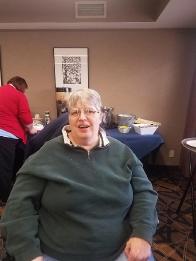
What's your story? Tell us a little bit about yourself.
Ginger was born with cerebral palsy. Her parents started advocating for her at a young age. She explains that as she grew up, she learned why it was important to advocate for things that would make her life easier and better. She is a very independent woman who lives in her own apartment with staff that comes in a couple days a week to help her with things that are hard for her to do.
How are you involved with self-determination? Why did you join the SD Network?
Ginger joined the Self-Determination Network so she could use it as a resource for her local People First group. She also as a tool in her own life.
Tell us some good news - what's the most exciting thing happening for you (or in Wisconsin) in terms self-determination?
Ginger explains that there are a couple things in Wisconsin that are great news to anyone with a physical challenge or intellectual challenge. The first thing is that last year Governor Walker signed a bill to make Supported Decision Making as an option to Guardianship. The second is that Governor Evers has signed Executive order #11 to create a task force to help caregivers in Wisconsin.
What tip or resource would you like to share with people who want to be more self-determined?
As Vice President of People First Wisconsin, Ginger knows everyone has the chance to start living a self-determined life. “Even if it is as simple as picking out the clothes that they want to wear that day,” she explains.
What are some of your hobbies?
Ginger is an avid sports fan. She loves watching Wisconsin sports teams—especially the Milwaukee Brewers, Green Bay Packers and the University of Wisconsin football. She also enjoys doing a lot of jigsaw puzzles and loves coloring in adult coloring books.
***We love hearing the views and opinions of Network members. We need to mention that the views and opinions expressed on this site are those of the person who is sharing them. They do not necessarily reflect InControl Wisconsin or any of our supporters and funders.
Apple recently announced that later this year 59 new emojis that represent people with disabilities will be released. People love using emojis to express emotion, talk to others, and shorten messages by sending emojis instead of words.
Soon people will be able to send a message with a service dog, a person using sign language, or even someone with prosthetic limbs. There are also such things as a hearing aid ear, a person using a wheelchair, or a person using a white cane will. There are even distinct guide dogs and service dogs.
ADMINISTRATION FOR COMMUNITY LIVING: Call for Nominations: Person-Center Planning Panel
By SD Network, 2019-02-28
The Centers for Medicare and Medicaid Services (CMS) is working with the Administration for Community Living through the National Quality Forum (NQF) to address quality measurement in person-centered planning. NQF is seeking individuals with experience in person-centered care to serve on a multi-stakeholder panel. The nomination period is open until March 29, 2019, at 6 PM.
Over an 18-month period, NQF will use a multi-stakeholder approach to address person-centered planning and practice (PCP) as part of long-term services and supports (LTSS) systems. Beginning with the establishment of definitions, core competencies, and necessary systems characteristics, this work will establish a foundation for performance measurement of person-centered planning, catalyzing the development of a robust quality measure set that interfaces with other healthcare quality measures across provider types, settings, payers, delivery systems, programs, conditions, and populations. Both practical as well as forward-looking considerations, recommendations, and guidance will be provided to enhance the success of person-centered planning and coordination at the state level.
Information about the project and the nomination project is on the NQF website
DISABILITY SCOOP: Dentists No Longer Permitted To Turn Away Patients Due To Disabilities
By SD Network, 2019-02-28
For people with disabilities, finding dental care is often a struggle. Nearly one-third of adults with disabilities in Wisconsin had a tooth removed in the last year and one in four had not been to a dentist in at least 12 months. The American Dental Association recently revised its code of conduct to prohibit denial of care to patients with physical, developmental or intellectual disabilities. If a dentist is not equipped to handle or accommodate an individual, the code requires them to refer the patient to an appropriate provider.