

News
ADMINISTRATION FOR COMMUNITY LIVING: Emergency Planning Toolkit for the Aging and Disability Networks
By SD Network, 2019-02-25
A new Capacity-Building Toolkit for Including Aging and Disability Networks in Emergency Planning is now available called the Capacity-Building Toolkit.
This resource guides aging and disability networks to increase their ability to plan for and respond to public health emergencies and disasters. This toolkit helps programs that support older adults and people with disabilities, through the emergency planning process of preparedness, response, recovery, and mitigation activities.
The toolkit was written by the National Association of County & City Health Officials and the Association of State and Territorial Health Officials, in partnership with the Office of the Assistant Secretary for Preparedness and Response and the Administration for Community Living.
It can help organizations of all types conduct more inclusive emergency planning by facilitating personal preparedness for aging adults and people with disabilities. It can also help expand organizational knowledge of the unique challenges these populations face during emergencies. The toolkit can assist emergency managers and public health officials in understanding the capabilities and expertise of community-based organizations within the aging and disability networks.
Organizations that are new to emergency planning can use this toolkit as an orientation to emergency planning. Those with established emergency preparedness programs can use it as a resource to enhance their capabilities..
THE ARC WISCONSIN: Exciting News! Governor Establishes Task Force on Caregiving
By SD Network, 2019-02-25
Last week, Governor Evers announced plans to establish a statewide Task Force on Caregiving. The Task force acknowledges the crisis and outlines steps to find solutions. A survey last year reported that 97% of Wisconsin families had trouble finding direct care workers. Many are hopeful this will help.
WISCONSIN BOARD FOR PEOPLE WITH DEVELOPMENTAL DISABILITIES: Dental Access Package & Dental Therapy Bill: How to Support the Bill
By SD Network, 2019-02-25
|
Finding dental care is a big problem for Wisconsinites with disabilities across the lifespan. A new bill could help more people get dental care. You can contact your legislators about it.
What is happening: A dental therapy bill (LRB 1947) has been introduced in the legislature; dental therapy is also part of a $43 million dental care package announced by Governor Evers that includes better funding to dentists who take Medicaid. What would the bill do: The bill would allow dental therapists to practice in Wisconsin like they do in other states. A licensed dental therapist works under the supervision of a dentist and can provide important preventative and restorative dental care. These programs in other states have increased dental care access to people who often have a hard time finding a dentist. What you can do: Call your legislator to talk about lack of access to dental care. Your legislators can co-sponsor the Dental Therapy bill: LRB 1947 and they can support the Governor’s dental funding package.
Things you can say:
|
DIGITAL JOURNAL: RespectAbility Presents Report: Best and Worst States on Jobs for People With Disabilities
By SD Network, 2019-02-23
Recent statistics show a slowdown in disability employment compared to the previous year. The newly published 2018 Annual Disability Statistics Compendium compiles data collected by the Census Bureau. The data shows that out of the more than 20 million working-age people with disabilities , 7.5 million are employed. Some states have higher employment rates for people with disabilities than others. Wisconsin ranks 17th with 41.9% of people with disabilities employed.
ADMINISTRATION FOR COMMUNITY LIVING: NIDILRR Announces Six New Funding Opportunities
By SD Network, 2019-02-23
The National Institute on Disability, Independent Living, and Rehabilitation Research (NIDILRR) at ACL is announcing funding opportunities for two new Advanced Rehabilitation Research Training (ARRT) programs, two new Rehabilitation Research and Training Center (RRTC) projects, and two new Disability and Rehabilitation Research Projects (DRRP):
- ARRT for Employment
- ARRT for Community Living and Participation
- RRTC on Employment and Community Living for Youth
- RRTC on Young Adults with Serious Mental Health Conditions
- DRRP on Health and Function (Research)
- DRRP on Health and Function (Development)
Advanced Rehabilitation Research Training
This program is funded through the Disability and Rehabilitation Research Projects and Centers Program to provide advanced research training and experience to individuals with doctorates (or similar advanced degrees) who have clinical or other relevant experience. ARRT projects train rehabilitation researchers, including researchers with disabilities, with particular attention to research areas that support the implementation and objectives of the Rehabilitation Act, and that improve the effectiveness of services authorized under the Rehabilitation Act.
ARRT projects under this opportunity announcement must provide advanced research training to eligible individuals to enhance their capacity to conduct high-quality multidisciplinary disability and rehabilitation research to improve outcomes for individuals with disabilities in NIDILRR’s major domain of employment.
Please visit the link above for more details about the grant opportunity and application process. This grant opportunity closes on April 8, 2019.
ARRT for Community Living and Participation
ARRT projects under this opportunity announcement must provide advanced research training to eligible individuals to enhance their capacity to conduct high-quality multidisciplinary disability and rehabilitation research to improve outcomes for individuals with disabilities in NIDILRR’s major domain of community living and participation.
Please visit the link above for more details about the grant opportunity and application process.This grant opportunity closes on April 8, 2019.
Rehabilitation Research and Training Centers
The purpose of the RRTC program, which are funded through the Disability and Rehabilitation Research Projects and Centers Program, is to achieve the goals of, and improve the effectiveness of, services authorized under the Rehabilitation Act through well-designed research, training, technical assistance, and dissemination activities in important topic areas as specified by NIDILRR. These activities are designed to benefit rehabilitation service providers, individuals with disabilities, family members, and other stakeholders.
RRTC on Transition to Employment for Youth and Young Adults with Serious Mental Health Conditions: The purpose of this particular RRTC is to conduct research, training, technical assistance, and related activities to contribute to improved employment outcomes for youth and young adults with serious mental health conditions. This funding opportunity reflects an ongoing collaboration between NIDILRR and the Substance Abuse and Mental Health Services Administration (SAMHSA).
Please visit the link above for more details about the grant opportunity and application process. This grant opportunity closes on April 15, 2019.
RRTC on Community Living and Participation for Youth and Young Adults with Serious Mental Health Conditions: The purpose of this particular RRTC is to conduct research, training, technical assistance, and related activities to contribute to improved community living and participation outcomes for youth and young adults with serious mental health conditions. This funding opportunity reflects an ongoing collaboration between NIDILRR and the Substance Abuse and Mental Health Services Administration (SAMHSA).
Please visit the link above for more details about the grant opportunity and application process. This grant opportunity closes on April 15, 2019.
Disability and Rehabilitation Research Projects (DRRP) Program
The purpose of the DRRP program is to plan and conduct research, demonstration projects, training, and related activities (including international activities) to develop methods, procedures, and rehabilitation technology that maximize the full inclusion and integration into society, employment, independent living, family support, and economic and social self-sufficiency of individuals with disabilities.
DRRP on Health and Function (Research): Applicants must propose a research project that is aimed at improving health and function outcomes of individuals with disabilities. A grantee must identify one or more hypotheses or research questions and, based on the hypotheses or research questions identified, perform an intensive, systematic study directed toward producing (1) new or full scientific knowledge, or (2) understanding of the subject or problem studied. Please note that this is the funding opportunity for field-initiated DRRP research projects in the health and function domain.
DRRP on Health and Function (Development): Applicants must propose a development project that is aimed at improving the health and function of individuals with disabilities. A grantee must use knowledge and understanding gained from research to create materials, devices, systems, or methods beneficial to the target population, including design and development of prototypes and processes. Please note that this is the funding opportunity for field-initiated DRRP research projects in the health and function domain.
Please visit the link above for more details about these grant opportunities and application process. These grant opportunities close on April 16, 2019.


February 2019
Connect | Share | Learn | http://sdnetworkwi.org/
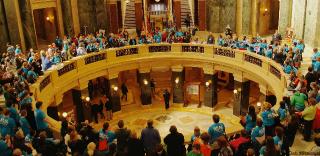
Hurry! Disability Advocacy Day Registration Ends Soon!
Register now for Disability Advocacy Day! Join fellow advocates on Wednesday March 20th in Madison to let your voice be heard. Disability Advocacy Day is designed to connect you with your legislators so you can talk about issues that matter to you. You are the expert in sharing how legislative policies affect people with disabilities in their everyday lives. The day starts with a briefing of issues you and your fellow constituents want to discuss with your legislators and after lunch the whole group heads to the capitol for their legislative meetings. Registration closes March 8th. Register today!

2019 Self-Determination Conference
Save the date! The 2019 Self-Determination Conference will be October 14th-16th at the Kalahari Resort and Conference Center in Wisconsin Dells. Are you interested in presenting? Presentation proposals are now being accepted and are due by noon on April 2nd. Submit your proposal today!

The Self-Determination Network includes some very talented members and we want to help you to get to know each other a little better. Member Spotlight is a great way for us to get to know each other better.
For February, we shine the spotlight on Hunter. When this author isn’t busy blogging on his website, he loves watching sports and going on adventures. He believes self-determination is a process and he encourages people to never ever give up. Stop by this month's Member Spotlight to get to know Hunter.

"Windchill warnings, polar vortex, below zero temperatures- people in Wisconsin have gotten very familiar with these terms recently. For people with disabilities, extreme temperatures (cold or hot) often create some unique challenges."

Take five minutes to check out what's happening on the Self-Determination Network:
- Accessibility Experts Needed: Do you know disability and accessibility laws really well? The U.S. Access Board is seeking Accessibility Specialists to serve in its Office of Technical and Information Services. Learn more about the positions.
- New Housing Complex: A group of parents who have adult children with disabilities is teaming up to develop housing for their children. Read about their plans.
- Eliminating Waiting Lists: Community-based services are often much harder to obtain than access to institutional care, but there is a new push underway to change that. Learn about new legislation that would ensure people eligible for institutional care would have access to the same services in their home.
- Medicaid Expansion: For many adults with disabilities, it's often a struggle determining whether or not it's worth it to work. Read about how even though some states are enacting new barriers for eligibility, many feel the Medicaid expansion still works for people with disabilities.
- Real-Time Captions and Translation Added to PowerPoint: Microsoft PowerPoint is adding live captions of voice translation to millions of Office 365 subscribers. Find out how this not makes it more accessible, but it could also increase employment for people with hearing impairments.
- Be Inspired: Perseverance and self-determination can make all the difference. Read how one young man is exceeding expectations!

Here's a sample of upcoming events listed on the Self-Determination Network:
- Webinar: Falls Prevention For Older Adults: February 13th, 11a.m to 12:30p.m., Online
- Webinar: The ADA, Businesses And Barrier Removal: What Are The Requirements?: February 19th, 1p.m. to 2:30p.m., Online
- The Wizard Of Oz Unplugged: March 7th, 9:30a.m. to 10:30a.m., Waukesha Civic Theatre, Waukesha WI
- The Wizard Of Oz Unplugged: March 7th, 12:30p.m. to 1:30p.m., Waukesha Civic Theatre, Waukesha WI
- The Wizard Of Oz Unplugged: March 8th, 9:30a.m. to 10:30a.m., Waukesha Civic Theatre, Waukesha WI
- The Wizard Of Oz Unplugged: March 8th, 7:30p.m. to 8:30p.m., Waukesha Civic Theatre, Waukesha WI
- The Wizard Of Oz Unplugged: March 9th, 2p.m. to 3p.m., Waukesha Civic Theatre, Waukesha WI
- The Wizard Of Oz Unplugged: March 9th, 7:30p.m. to 8:30p.m., Waukesha Civic Theatre, Waukesha WI
- The Wizard Of Oz Unplugged: March 10th, 2p.m. to 3p.m., Waukesha Civic Theatre, Waukesha WI
- Long Term Care Advocacy Team: March 12th, 2:30p.m. to 3:30p.m., IndependenceFirst, Milwaukee WI
- Advocacy For Change: March 13th, 8:30a.m. to 4:30p.m., Concourse Hotel, Madison WI
- Disability Advocacy Day: March 20th, 9:30a.m. to 3:30p.m., Monona Terrence, Madison WI
- Transportation Consumer Advocacy Team (TCAT): March 26th, 1p.m. to 3p.m., IndependenceFirst, Milwaukee WI
Post your event on the Self-Determination Network and it can be included in future Network News emails to members! Questions? Suggestions? Contact Stacy Ellingen.

The Self-Determination Network is powered by InControl Wisconsin and supported financially by our members and Sponsors. We couldn't keep this Network going with you! Find out how you can help support the Network.
MILWAUKEE JOURNAL SENTINEL: Born with a brain injury, this young man has accomplished more than anyone ever imagined
By SD Network, 2019-02-11
Perseverance and self-determination can make all the difference. For Ben Page, that couldn't be more true. Due to an injury at birth, this 22 year old has an intellectual disability, but he hasn't let that stop him from leading a successful life. Doctors warned his parents not to expect much from Ben's development, but they started to view his progress through the lens of his own abilities. He has exceeded everyone's expectations!