

News
Caring for loved ones with special needs is often very rewarding, but it can also take a physical, emotional and financial toll on families. Many families rely on respite care as a reprieve. A bipartisan bill introduced this month known as the Lifespan Respite Care Reauthorization Act of 2019, would tag $200 million over the next five years to boost respite care services across the country.
DISABILITY SCOOP: Trump Approves Extension Of Program Helping People Leave Institutions
By SD Network, 2019-04-23
Legislation that the President recently signed ensures that a program that moves people with disabilities from institutions to the community can stick around while advocates push for a longer-term solution. The President allocated an additional $20 million to Money Follows the Person. Through the program, states can access Medicaid funding to pay for employment supports, housing and other services so that people with disabilities can transition from nursing homes and other institutional facilities to homes in the community.

April 2019
Connect | Share | Learn | http://sdnetworkwi.org/
Advocacy Award Nominations
Do you know somebody who has gone to extraordinary lengths to advocate for people with disabilities? The Wisconsin Council on Physical Disabilities (CPD) is pleased to announce the Dan Johnson Advocacy Award. This award is in memory of Dan and his many accomplishments and was created to recognize people with physical disabilities who are outstanding advocates.
The Dan Johnson Advocacy Award is aimed at recognizing excellence in advocacy, and public policy change for people with physical disabilities, rather than disability advocacy. Individuals nominated should be people with physical disabilities who advocate for people with physical disabilities and have had a positive impact on federal or state legislation, public policy, or programs that affect people with disabilities in Wisconsin. The advocacy work conducted should exceed normal expectations of regular advocacy practice, and should be inclusive and respectful of the values and independence of those who are affected by it. The nomination deadline is June 30th. Learn more and nominate someone today!

The Self-Determination Network includes some very talented members and we want to help you to get to know each other a little better. Member Spotlight is a great way for us to get to know each other better.
For April, we shine the spotlight on Don and Tyler. For this dynamic father/son duo, life centers around sports. Tyler, a Special Olympian, has traveled all around the world competing in many different sports. For dad, Don, volunteering with Special Olympics ultimately led to a career switch, so he could make an impact in the lives of people with disabilities. Although it isn't easy, he encourages parents with children with different abilities to push them to their fullest, so they can be productive members of society. Stop by this month's Member Spotlight to get to know Don and Tyler.

"Ever feel like there isn’t enough time in the day? Sometimes, it seems difficult to find time for everything. For people with disabilities and health conditions, it’s no different. Often, we have some additional things, such as appointments, treatments, and cares to juggle."
In this month's entry, Stacy talks about how recent medical appointments and treatments have her trying to find a balance in life. How do you find a balance in your life? We encourage you to share your thoughts and experiences as well.

Take five minutes to check out what's happening on the Self-Determination Network:
- Removal of "Derogatory Language": Recently, Governor Evers issued an order to remove "derogatory language" from the state administrative code. Learn which terms will be removed and what they will be replaced with.
- Marital Status Bill: Under current law, when two people who rely on Supplemental Security Income marry, their benefits can be at risk because they must jointly report their income. Find out how, under a new proposed bill, that and other rules regarding SSI and marriage would change.
- "Community-Based" Clarification: Federal officials have released guidance to clarify what living arrangements for people with disabilities are considered to be "community-based." Read about what the criteria is.
- Airlines Disclose Damages: Thanks to a new law, for the first time ever, airlines had to publicly report how many wheelchairs or scooters they broke or lost. Find out what was revealed.
- Grant Opportunity for Transition Age Youth: The Administration on Community Living announced a grant opportunity for research, training, technical assistance and related activities to improve employment outcomes of transition age youth with disabilities. The grant application is due May 24th.
- Furniture Attachment Blueprints: For people with disabilities, using regular furniture can often be challenging. Learn about what one store is doing to furniture more accessible for everybody to use.
- Research Funding Grant Opportunity on Employment: The Administration on Community Living announced a grant opportunity for research, training, technical assistance and related activities to improve employment outcomes of people wit developmental and intellectual disabilities. This grant opportunity closes May 28th.
- Uproar Brings Attention to Other Program Cuts: Recent uproar over a proposal to end federal funding for Special Olympics has brought attention to other potential harmful cuts to programs for people with disabilities. Read about how advocates are using the situation as a great opportunity to inform lawmakers about other harmful cuts.
-
Exhibitor Opportunity: Do you create jewelry, candles, art, or knit goods? Do you teach piano or offer consulting for social media? If you have any services or products that you want to tell the Madison disability community about, the Disability Pride Madison festival is for you! Learn more and sign up today!

Here's a sample of upcoming events listed on the Self-Determination Network:
- Webinar: Using An ABLE Account To Support Youth From Transition To Independent Living: April 25th, 1p.m. to 2p.m., Online
- Self-Advocacy Spotlight : April 30th, 6p.m. to 8p.m., WI FACETS, Milwaukee WI
- 2019 Circles Of Life Conference: May 2nd & 3rd, Holiday Inn Convention Center, Stevens Point WI
- Webinar: Accessible Sales And Service Counters: May 2nd, 1:30p.m. to 3p.m., Online
- Dance Card: May 3rd, 7:30p.m. to 9p.m., Shattuck Music Center at Carroll University, Waukesha WI
- Long Term Care Advocacy Team: May 14th, 2:30p.m. to 3:30p.m., IndependenceFirst, Milwaukee WI
- Transportation Consumer Advocacy Team (TCAT): May 28th, 1p.m. to 3p.m., IndependenceFirst, Milwaukee WI
- Long Term Care Advocacy Team: June 11th, 2:30p.m. to 3:30p.m., IndependenceFirst, Milwaukee WI
- Transportation Consumer Advocacy Team (TCAT): June 25th, 1p.m. to 3p.m., IndependenceFirst, Milwaukee WI
Post your event on the Self-Determination Network and it can be included in future Network News emails to members! Questions? Suggestions? Contact Stacy Ellingen.

The Self-Determination Network is powered by InControl Wisconsin and supported financially by our members and Sponsors. We couldn't keep this Network going with you! Find out how you can help support the Network.
Disability Pride Madison is delighted to offer the opportunity to exhibit your products and services! We've had so many incredible vendors in the past - from our friends at Wisconsin Talking Books to the Madison Children's Museum to the Community Living Alliance! If you provide a valuable service to the disability community, we would love for you to come and celebrate with us at the Disability Pride Festival 2019!
We also are offering a unique chance for people with disabilities who operate a microbusiness (a business with a total yearly profit of $20,000 or less) to exhibit with us for FREE! Do you create jewelry, candles, art, or knit goods? Do you teach piano or offer consulting for social media? If you have any services or products that you want to tell the Madison disability community about, this festival is for you! In the past, we've been so lucky to partner with small businesses like Cocoa Bean Skin Care and CLW Productions fiber art! You will have a table underneath a canopy to show off whatever you have to sell or just display! If you have any questions, you can simply send us an email at disabilitypridemadison@gmail.com!
Please spread the word far and wide about this opportunity! We want to see you, your friends, and your family at the festival this summer!
DISABILITY SCOOP: Special Olympics Uproar Draws Attention To Other Disability Program Cuts
By SD Network, 2019-04-08
Recent uproar over a proposal to end federal funding for Special Olympics has brought attention to other potential harmful cuts to programs for people with disabilities. The President later recinded the proposal to cut funding for Special Olympics; however, the budget still calls for cuts to Medicaid and eliminating funding for autism training and research. It also includes cuts for employment support for people with disabilities.
While advocates are concerned about the proposals, they feel the uproar over the Special Olympics cut has given them a prime opportunity to inform lawmakers and the public while disability funding has been fresh in the news cycle and on social media.
ADMINISTRATION FOR COMMUNITY LIVING: New Research Funding Opportunity on Employment of People with Intellectual and Developmental Disabilities
By SD Network, 2019-04-08
The National Institute on Disability, Independent Living, and Rehabilitation Research (NIDILRR) at ACL is announcing a funding opportunity for a new Rehabilitation Research and Training Center (RRTC) project.
Rehabilitation Research and Training Centers
The purpose of the RRTC program, which are funded through the Disability and Rehabilitation Research Projects and Centers Program, is to achieve the goals of, and improve the effectiveness of, services authorized under the Rehabilitation Act through well-designed research, training, technical assistance, and dissemination activities in important topic areas as specified by NIDILRR. These activities are designed to benefit rehabilitation service providers, individuals with disabilities, family members, and other stakeholders.
RRTC on Employment of People with Intellectual and Developmental Disabilities:The purpose of this particular RRTC is to conduct research, training, technical assistance, and related activities to contribute to improved employment outcomes of people with intellectual and developmental disabilities.
Please visit the link above for more details about the grant opportunity and application process. This grant opportunity closes on May 28, 2019.
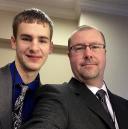
What's your story? Tell us a little bit about yourself.
Don is the proud father three adult children—two boys and a girl. He has a Bachelor of Science degree in Chemistry and a Master’s degree in Biochemistry, but, after volunteering for seven years with the organization, in 2010, he became the Vice President of Sports & Health Programs with Special Olympics Wisconsin. He made the switch to the non-profit to make an impact in the lives of people with disabilities. His middle child, Tyler, is a Special Olympian.
Tyler lives independently in a condo with the assistance of a part-time caregiver. He works in the online ordering department at Woodmans. He participates in Special Olympics and has competed in over nine sports including track, bowling, alpine skiing, basketball, softball, soccer, volleyball, tennis, and flag football. He went to the 2014 Special Olympics USA games and won a gold medal on the state flag football team. As the Special Olympics Wisconsin Health Leader and Global Ambassador, he promotes healthy lifestyle and spreads the positive message of Special Olympics. He has raced in multiple half-marathons (best time 1hr 36min) and one full marathon (3hr 39min). He has competed in world level competitions in track (Ecuador) and half-marathon Portugal) and is currently training for the World Track & Field Championships for athletes with intellectual disabilities in Australia this October.
How are you involved with self-determination? Why did you join the SD Network?
Don shares that he has always been a strong proponent of finding ways for individuals to help create and fulfill their life dreams. He explains that he and his wife raised Tyler in a way that they were always preparing him to be able to live on his own, and their school district did a very good helping Tyler learn work skills that transitioned in many years at Panera Bread and now Woodman’s. “Tyler loves being productive and bring home a paycheck. He had been planning on moving out for several years and last October that dream because a reality,” he says.
Tell us some good news - what's the most exciting thing happening for you (or in Wisconsin) in terms self-determination?
Don is extremely proud that Tyler is living on his own. He explains that young adults of any ability dream of moving out from mom/dad’s house and living independently. Young adults with disabilities are no different.
For Tyler, the Paralympic running experience has been pretty exciting. He is able to travel on his own with the USA Team.
What tip or resource would you like to share with people who want to be more self-determined?
Don encourages parents not to treat your child different just because they have a disability. He says to push them and help them grow to be productive members of society that will someday not need mom or dad. “That is hard as parents. Especially when you have a child with a disability. Also help prepare them for life without you,” he says.
What are some of your hobbies?
In his free time, Don enjoys reading, doing crosswords, hiking, and watching sports. When Tyler isn’t busy working or training, he enjoys watching sports and hanging out with friends.
***We love hearing the views and opinions of Network members. We need to mention that the views and opinions expressed on this site are those of the person who is sharing them. They do not necessarily reflect InControl Wisconsin or any of our supporters and funders.
The legislature's Joint Finance (budget writing) committee is holding four hearings across the state to gather public input on the state budget (see below for dates and locations).
Committee members have said how helpful it is to have real people share their stories and illustrate what makes a difference in their lives, and where improvements are needed. Joint Finance Committee hearings are an important opportunity for families to highlight budget proposals for the committee. To see an in-depth summary of the Governor’s budget go to https://familyvoiceswi.org/wp-content/uploads/2019/03/State-Budget-Summary-from-Family-Voices-of-WI-.pdf.
A few key issues for children with disabilities for the Joint Finance Committee http://www.survivalcoalitionwi.org/index.php/budget-priorities/
- END Wait Lists - Ensure that all children eligible for the children’s long-term support program can receive services. Provide “sum sufficient” funding for all eligible children in the Medicaid budget so that no child with a disability is left waiting for needed supports and services.
- SUPPORT FAMILIES - Support $4.5M for a “no wrong door” or Family Support and Disability Resources to support families including: children's services navigators; disability resource specialists; and advocacy services to help families access and navigate available community resources, programs, and services.
- SPECIAL EDUCATION - Increase state special education reimbursement to local school districts from 24% to 60%.
If you are unable to attend a hearing in person, you can submit your comments on the state budget to: budgetcomments@legis.wisconsin.gov
Public hearing dates and locations:
Friday April 5th
10 AM to 5 PM
Pontiac Convention Center
2809 North Pontiac Drive
Janesville, WI 53545
Wednesday April 10th
10 AM to 5 PM
Oak Creek Community Center
8580 South Howell Ave
Oak Creek, WI 53154
Monday April 15th
10 AM to 5 PM
University of Wisconsin River Falls
University Center, Riverview Ballroom #260
500 Wild Rose Avenue
River Falls, WI 54022
Wednesday April 24th
10 AM to 5 PM
University of Wisconsin Green Bay
University Union, Phoenix Rooms
2430 Campus Court
Green Bay, WI 54311