

News
INTERNATIONAL AIRPORT REVIEW: Handbook to enhance air travel experience of passengers with disabilities
By SD Network, 2018-10-04
The Airports Council International World (ACI) has put out a new edition of its Airports & Persons with Disabilities Handbook. The handbook has new policies designed to help travelers with disabilities. These policies will affect travel technology and facilities. While some American international airports are members of ACI, all airports in America are bound by federal standards of accessibility. However, International watchdog agencies are still concerned as accessibility remains a concern for travelers outside of America.
U.S. ACCESS BOARD: Access Board Celebrates 50 Years of the Architectural Barriers Act
By SD Network, 2018-10-04
In 1968, Congress took its first steps to make sure there was access to federal buildings for people with disabilities. The Architectural Barriers Act (ABA) stated that any buildings that were built or altered with federal dollars must be accessible. The ABA allowed buildings that predate it to remain as they were. This was the first disability law in the United States. It paved the way for the Rehabilitation Act and Americans with Disabilities Act that would further expand disability rights. Things that make buildings more accessible are ramps, accessible parking, elevators, and other features. Post offices, national parks, and Veterans Affairs facilities fall under the ABA. The ABA even covers nongovernmental facilities, such as certain schools, transit systems, and public housing that received federal funding.
THE COMMON WEALTH: Creating Better Systems of Care for Adults with Disabilities: Lessons for Policy and Practice
By SD Network, 2018-10-02
This is very detailed report discussing programs serving three categories of people with disabilities: physical disabilities, intellectual and developmental disabilities, and mental illness. Under each category, it lists different nationality known programs for each particular group. At the end of the report, it discusses shared features of programs that support all three categories. it's jammed packed full of very interesting information.
This is an excellent podcast about the home health care crisis. It explains in-in-depth how the crisis will soon be affecting everybody in one way or another. it discusses economic and political factors that created this crisis and what will happen if things don't change.
US NEWS AND WORLD REPORTS:10 Ways to Support Self-Sufficiency for People With Disabilities
By SD Network, 2018-10-02
Landmark laws and advancements in technology are often credited as helping people with disabilities succeed. While this is true, things such as community planning, low-tech devices, and common sense adaptations also play a critical part in helping people live safely and independently. This article discusses 10 ways to support self-sufficiency and inclusion.
|
The American Association on Health and Disability (www.aahd.us) is accepting applications for the Frederick J. Krause Scholarship for undergraduate (sophomore standing and above) and graduate students with disabilities who are majoring in a field related to disability and health. Please feel free to distribute to your colleagues.
SCHOLARSHIP PROGRAM CRITERIA: The AAHD Frederick J. Krause Scholarship on Health and Disability is awarded annually to deserving students with a disability, pursuing undergraduate/ graduate studies (must be at least enrolled as a Sophomore in college) in an accredited college or university. Preference is given to students majoring in a field related to disability and health, to include, but not limited to public health, health promotion, disability studies, disability research, rehabilitation engineering, audiology, disability policy, special education, occupational therapy, physical therapy and majors that will impact quality of life of persons with disabilities.
Applicant must have a disability and enrolled FULL TIME as an undergraduate student (sophomore standing and above) or enrolled PART TIME or FULL TIME in a graduate school. Applicant must be a US citizen or legal resident living in the US and enrolled in an accredited US university. Funds are limited to under $1,000.
FUNDING INFORMATION: Funds are limited to under $1,000. The AAHD Board of Directors Scholarship Committee will evaluate each of the applicants and make a decision in December of each calendar year. The 2018-2019 Scholarship Award will be awarded January 2019. It is the discretion of the Scholarship Committee to determine how many scholarships will be awarded each year and the amount of each scholarship.
APPLICATION REQUIREMENTS:
Applicant must provide a Personal Statement (maximum 3 pages, double spaced), including brief personal history, educational/career goals, extra-curricular activities, and reasons why they should be selected by the AAHD Scholarship Committee. This statement must be written solely by the applicant.
Applicant must provide two (2) Letters of Recommendation (One must be from a faculty member or academic advisor). Letters may be sent by U. S. mail or by email attachment as pdf and should include the signature of the faculty member or advisor, and the name of student should appear in the subject line of the email.
Applicant must provide an official copy of college transcript, which should be mailed to AAHD in a sealed envelope.
Applicant must agree to allow AAHD to use their name, picture and/or story in future scholarship materials.
Applications are due November 15, 2018.
APPLICATION FORM: PDF
Please attach your application, supporting materials, etc. and email to: scholarship@aahd.us. Place “2018-19 Scholarship” in subject line. (Please use MS Word for your personal statement and MS Word, if at all possible, and/or PDF for all other documents that are emailed as attachments). If this is not possible, please mail documents to:
AAHD Scholarship Committee
American Association on Health and Disability
110 N. Washington Street, Suite 328-J
Rockville, MD 20850
|
|
Only completed applications will be considered and must be postmarked and/or received by email no later than November 15, 2018
|
COMMONWEALTHFUND; Trying to Survive: Community Responses to Uncertainties About Federal Funding for Medicaid and Public Health Programs
By SD Network, 2018-09-26
Health departments and community clinics report that local funding has been inadequate for some time. As state and county governments have resisted raising taxes and increasing funds for public health needs and community clinics, grants from local organizations and foundations have helped fill the breach, but private philanthropy only goes so far. Changes to Medicaid payment, along with proposed eligibility changes and fears of funding cutbacks, are causing grave concerns among community health leaders.
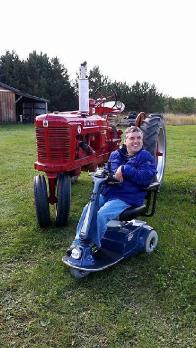
How are you involved with self-determination? Why did you join the SD Network?
Jeff has cerebral palsy and uses a motorized scooter to get around; he also speech impediment, but that doesn’t stop him from leading a great life. He joined the Network because he wanted to help people and be there for them.
Tell us some good news - what's the most exciting thing happening for you (or in Wisconsin) in terms self-determination?
Jeff really likes the fact that he can choose what he wants for his care. He has been an IRIS participant for about eight years; being able to have choice means a lot to him.
What tip or resource would you like to share with people who want to be more self-determined?
Jeff wants to encourages people to always keep a positive attitude no matter what life throws at them. He explains that it makes him feel really good when people ask him for help, and because he keeps a positive attitude, people connect with him. He says, “it’s a great feeling.”
What message would you like to share with the members of the SD Network?
Jeff loves being a member of the Network. He likes that people are friendly and they are there for you. He also explains that the Network has good resources. “You guys do excellent work,” he says.
What are some of your hobbies?
Jeff enjoys meeting new people and being outside when it is nice. He also loves listening to music—especially classic rock from the 70s and 80s.
***We love hearing the views and opinions of Network members. We need to mention that the views and opinions expressed on this site are those of the person who is sharing them. They do not necessarily reflect InControl Wisconsin or any of our supporters and funders.